
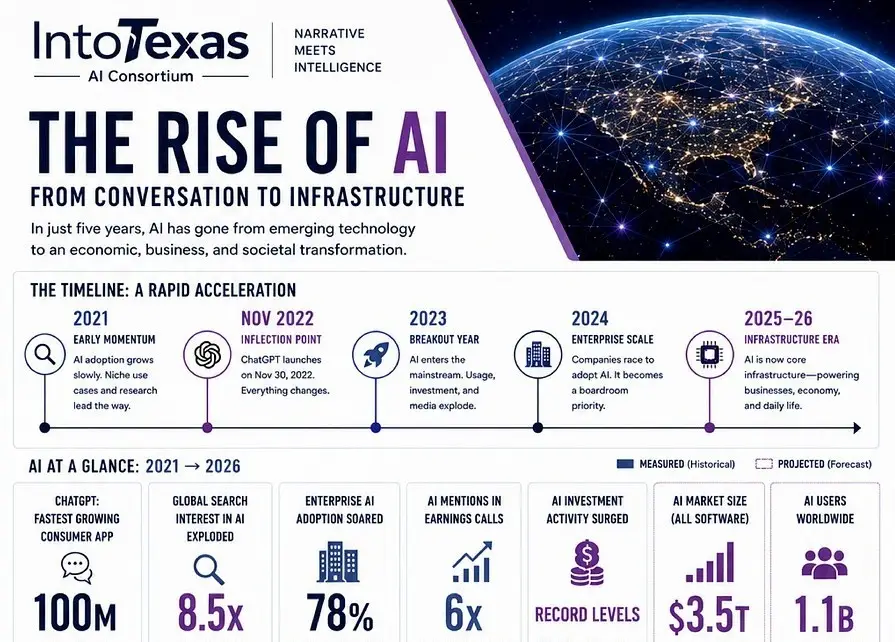

Infographic | Rise of AI Infrastructure
AI has moved from conversation to infrastructure. Explore the trends in adoption, investment, jobs, data centers and economic growth shaping the AI era.
 Peter Blocker
Share This Post
AI is now widely used inside companies, but “use” is not the same as measurable return. Employees may have increased efficiency of some tasks – from content creation to data analysis. Perhaps key workflows have been automated. That’s progress. Yet many leadership teams still struggle to point to a change in revenue, cycle time, quality or even customer retention.
That gap is not an AI capability problem. It is a value-conversion problem.
The central operating question is no longer, “Are our people using AI?” It is, “What changed in the business because they are using it?”
AI adoption has accelerated faster than enterprise value.
Writer’s 2026 enterprise AI survey captured the contradiction clearly. Nearly all executives surveyed (97%) said AI had been beneficial, but only 29% reported significant ROI from generative AI and 23% from AI agents. The same research found that most leaders see AI “super-users” as at least five times more productive than employees who aren’t embracing AI.
McKinsey’s 2025 global AI survey reached a similar conclusion from a broader market view. AI use had become common, with 88% of respondents saying their organizations use AI in at least one business function, yet only 39% reported any enterprise-level EBIT impact. The small group of high performers was more likely to redesign workflows, pursue transformative business goals and scale proven practices rather than distribute tools and wait for value to emerge.
The pattern is consistent: AI can be useful almost immediately at the individual level, while organizational returns remain difficult to capture.
Suppose 100 employees each save two hours a week using AI. On paper, the company has created 200 hours of weekly capacity. But the accounting value of those hours depends on what happens next.
If employees use the time to complete the same workload with less stress, the benefit is real but may not appear as revenue or cost reduction. If demand is constrained, the business cannot automatically sell the additional capacity. If the old workflow remains unchanged, bottlenecks may simply move to another team. If output increases but review time, error correction or governance costs also rise, the gross productivity gain may overstate the net return.
This is why multiplying estimated hours saved by employee compensation often produces an attractive but misleading ROI calculation. It treats capacity as though it were cash.
A more credible business case asks whether the organization used the released capacity to avoid hiring, increase throughput, accelerate revenue, improve quality, reduce external spending, shorten working-capital cycles or decrease measurable risk.
AI ROI can be understood as a chain with five links. If one link is missing, useful activity may never become enterprise value.
A business problem is clearly defined
The starting point should be a costly delay, recurring error, customer problem, missed opportunity or capacity limit—not a tool looking for a use case. A manufacturer may need to reduce production interruptions. A professional-services firm may need to shorten proposal cycles. A distributor may need to improve order accuracy or respond to customers faster.
The workflow is redesigned
Adding AI to the existing process often creates faster fragments inside a slow system. The full workflow must be examined: inputs, handoffs, approvals, exceptions, data access and ownership. The objective is not to automate every step. It is to redesign the sequence around what humans and AI can each do best.
Released capacity is assigned a destination
Leaders need to decide where saved time will go before the pilot begins. Will the team process more transactions? Reduce an external service cost? Avoid a planned hire? Improve account coverage? Shorten a backlog? Without that decision, productivity gains remain scattered across calendars rather than captured in the operating plan.
The outcome has an accountable owner
A pilot can have a project manager while the business result has no owner. Someone must be responsible for the operating metric that should change. That person needs authority to redesign work, coordinate across departments and stop a use case that creates activity without value.
Financial and operational results are measured together
Usage, prompt volume and user adoption are diagnostic measures. They help explain what is happening, but they are not the final result. Leaders should pair them with measures such as revenue per employee, cost per transaction, cycle time, first-contact resolution, defect rates, forecast accuracy, conversion, retention or avoided cost.
Consider a mid-market professional-services company whose teams spend substantial time creating proposals. It introduces generative AI to summarize client requirements, retrieve relevant past work and draft first versions. Employees report that each proposal takes three fewer hours to prepare.
The initial dashboard looks impressive: 600 hours saved in a quarter. But revenue does not change. The approval process still takes a week. Senior experts remain a bottleneck. Sales teams continue submitting incomplete requests. The company has made one step faster without changing the commercial system around it.
A redesigned workflow would standardize intake, identify which proposals deserve priority, create an approved knowledge library, assign review thresholds and route only high-risk sections to senior experts. The company could then use the capacity to submit more qualified proposals, respond earlier in competitive cycles and reduce outside writing support.
Now the measurement changes. Instead of reporting only hours saved, leadership can track proposal cycle time, number of qualified proposals completed, external cost avoided, win rate and revenue influenced. The AI tool did not create the ROI by itself. The redesigned operating process converted capability into value.
Many AI initiatives become difficult to evaluate because the organization never measured the original process. Before implementation, capture a baseline for volume, labor effort, delay, quality, rework, cost and business outcome. The baseline does not need to be perfect, but it must be credible enough to show whether performance actually changed.
A useful pilot baseline includes the number of transactions or cases, average cycle time, employee hours, error or rework rate, external costs, customer impact and the financial value of the outcome. It should also identify current constraints. If demand, approvals or data access limit the process, faster task execution may not improve the final result.
After launch, compare net improvement rather than gross automation. Include new costs such as model access, integration, training, human review, monitoring, security and workflow maintenance. The right question is not merely how much time AI saved. It is how much economic value the redesigned process produced after all incremental costs.
At a basic level, leaders can calculate AI ROI as:
ROI = (Annualized financial benefit – Annualized AI cost) / Annualized AI cost
Financial benefit may include avoided labor or hiring, additional contribution margin, reduced vendor spending, lower error costs, faster cash collection or quantifiable risk reduction. AI cost should include software, integration, data preparation, training, governance, review and ongoing maintenance.
The formula is useful, but only after the operating assumptions are proven. A theoretical labor saving should not be counted as a cash benefit unless the company can show how the capacity was captured. Revenue influenced should not be treated as revenue caused. Risk reduction should be based on defensible probabilities and expected loss, not a vague claim that the system makes the company safer.
Mid-market organizations face a particular challenge. They are complex enough to have cross-functional workflows, legacy systems and governance requirements, but they may not have large transformation teams or dedicated AI teams or resources. Employees are already stretched, and the same leaders responsible for daily performance are often expected to manage AI adoption.
That makes prioritization more important. A mid-market company does not need dozens of disconnected pilots. It needs a small portfolio of use cases tied to meaningful operating constraints, each with a baseline, accountable owner, redesigned workflow and agreed measurement plan.
The advantage is that mid-market companies can often move faster once leadership is aligned. Decision paths may be shorter, process owners are easier to identify and the distance between executives and frontline work is smaller. The constraint is not necessarily size. It is the discipline to choose fewer, better-defined problems and follow them through to measurable results.
A useful executive dashboard separates three categories. Adoption measures show whether people are using the approved tools. Operational measures show whether the process is performing differently. Financial measures show whether that operational change created economic value.
For example, active users and workflow runs belong in the adoption category. Proposal cycle time, service resolution or production downtime belong in the operational category. Avoided cost, margin improvement, revenue acceleration or working-capital benefit belong in the financial category.
When all three appear together, leaders can see the conversion path. When the dashboard ends with usage, the organization can mistake activity for success.
The next stage of AI adoption will not be won by the companies with the largest number of licenses or pilots. It will be won by organizations that connect AI to priority business constraints, redesign the work, assign accountability and measure the result in operating and financial terms.
Individual productivity is valuable. It can reduce frustration, improve quality and create capacity. But it becomes enterprise ROI only when leadership decides how that capacity will change the economics of the business.
The real question is not whether AI helped someone work faster. It is whether the business now performs better—and can prove it.
Sources
Share This Post
AI has moved from conversation to infrastructure. Explore the trends in adoption, investment, jobs, data centers and economic growth shaping the AI era.


Learn how leaders can redesign work, map human and AI responsibilities, and avoid costly AI-driven layoffs followed by correction hires.

Learn how to create practical AI guidelines by job function so employees know what to use, what to avoid and how their roles will change.
Find services, insights, articles and resources.