
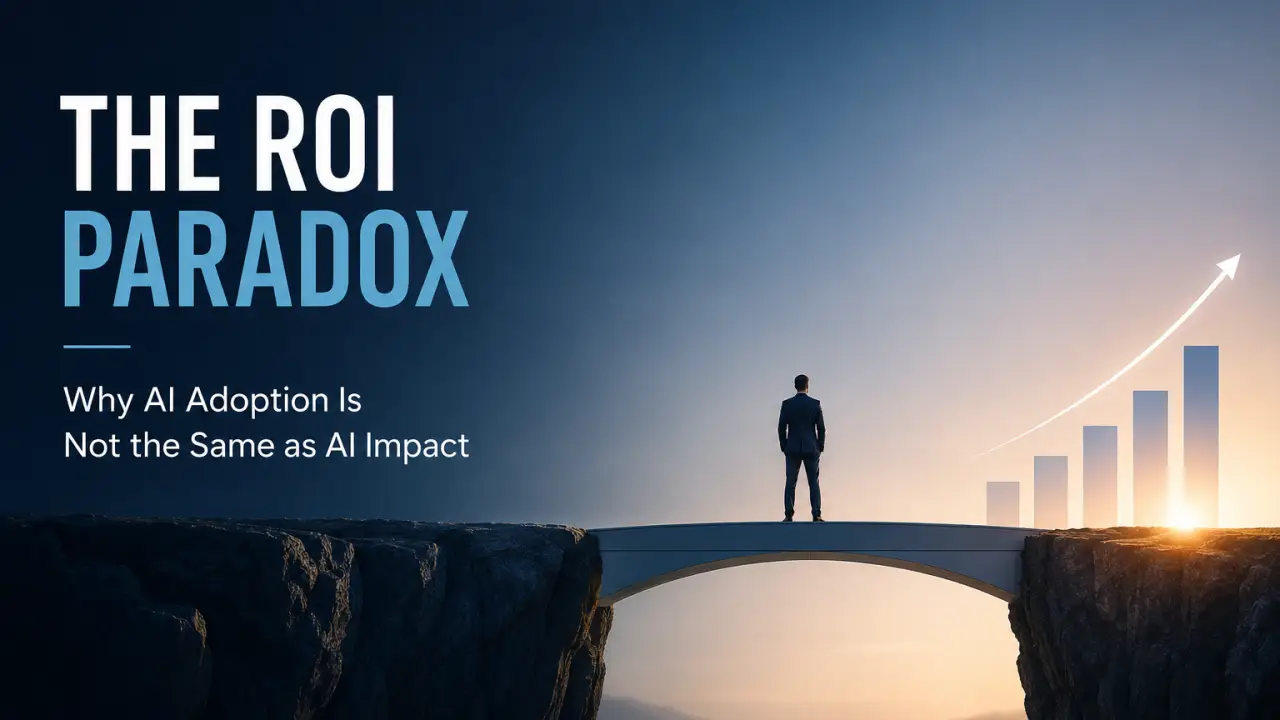

Why AI Productivity Gains Do Not Show Up in the P&L
Learn why AI adoption and time savings often fail to improve financial performance, and how leaders can redesign workflows to capture measurable AI ROI.
 Peter Blocker
Share This Post
AI Workforce Planning
Companies are under pressure to show that their AI investments are producing measurable gains. That pressure can quickly turn a productivity discussion into a headcount discussion: If AI can complete more of the work, does the business still need the same number of people?
The question is understandable. The sequence is often wrong.
Before leaders decide that a job can be eliminated, they need to determine how the work will operate after AI is introduced. That requires more than counting tasks that can be automated. It starts with mapping human judgment to functions and outcomes – including accountability, customer relationships, institutional knowledge and exception handling. Even when implemented flawlessly, the realization should be that AI systems create the requirement for continued human oversight.
The operating principle is simple: redesign the work before removing the worker.
Companies that skip that step risk creating an AI workforce-planning problem that looks efficient in a budget model but becomes expensive in practice. They may cut a role, discover that critical responsibilities were never transferred, overload the remaining team and eventually rehire someone to perform much of the same work under a different title.
The challenge surfacing is described as the “AI human boomerang”: companies eliminating roles because of expected AI or automation gains and later bringing those roles, or close versions of them, back. While this is a new realization there’s already supporting data that this could be more than a trend.
Robert Half reported in 2026 that three in ten employers eliminated positions after implementing AI but later added those roles back. Many had moved too quickly, underestimating how much human judgment, context and decision-making those roles required.
Gartner has documented a similar pattern in customer service. It predicts that by 2027, half of companies that attributed headcount reductions to AI will rehire people to perform similar functions, but under different job titles. Its research also found that only 20% of customer service leaders had actually reduced agent staffing because of AI, while 55% reported stable staffing while handling higher customer volumes. By April 2026, Gartner reported that 85% of service leaders were expanding human agent responsibilities as routine work shifted to AI.
That is not an indication that AI has failed. It is evidence that automation and workforce elimination are not the same business decision.
Microsoft joined a growing list of enterprise companies that eliminated chunks of its workforce in 2026. Its RIF (reduction in force) spanned approximately 4,800 roles, or about 2.1% of its global workforce.
Microsoft’s own explanation of the RIF is interesting – and a bit different from the typical corporate reasoning that comes with tech layoffs. The company said customer needs, business models and the work itself were changing, and stated directly that the eliminated roles were not being replaced by AI. It also said it had redeployed more than 4,000 employees into new roles during the previous year, including another 500 during the month of the layoffs.
Restructuring may still include job losses, but redeployment recognizes that AI changes where labor creates value rather than merely erasing the need for labor. The practical leadership challenge is to determine which work should be automated, which work should move, which roles should be broadened and which capabilities must remain under human ownership.
Most business roles are bundles of visible tasks and invisible responsibilities. The visible tasks are usually the easiest to identify: preparing reports, answering routine questions, reconciling data, drafting documents, scheduling work or updating systems. Those activities are often legitimate candidates for automation.
The invisible responsibilities are harder to capture. An experienced employee knows which customer needs a phone call instead of an automated response. A manager recognizes when an apparently routine exception could become a compliance issue. An operations coordinator knows which vendor can solve a problem in two hours and which one will require three follow-ups. A finance employee may understand why a recurring discrepancy is harmless in one account but dangerous in another.
AI may support those decisions, but the business still needs someone to own the outcome. When leaders remove the person because a tool can perform several tasks, they can accidentally remove the judgment, context and accountability that held the role together.
This risk is especially high in mid-sized businesses. Roles are often broader than their job descriptions suggest, and processes may depend heavily on informal knowledge. One employee can carry pieces of customer service, reporting, vendor coordination, compliance and operational memory. A spreadsheet that lists only the employee’s recurring tasks will miss much of the value.
A better approach begins with work mapping and human-and-AI role mapping. The objective is not to protect every existing job or to prevent necessary restructuring. It is to make workforce decisions with a complete picture of how the business actually operates.
Consider a mid-sized distributor that introduces an AI service agent. The system can answer order-status questions, summarize account history, draft responses and classify incoming requests. A task-level analysis may suggest that several service positions can be removed.
A work-level analysis produces a different picture. Routine contacts decline, but the remaining cases are more complex. Customers reach human employees when orders are late, specifications are unclear, pricing is disputed or a key account is at risk. The service team also has to review AI-generated answers, improve the knowledge base, flag recurring product issues and determine when an exception should go to sales, operations or finance.
The redesigned role may support more customers with fewer repetitive tasks, but it becomes more valuable, not less. The employee shifts from answering every question to managing exceptions, protecting relationships and improving the AI-supported service system. The business may eventually need fewer entry-level transactions, but it may also need stronger escalation specialists, knowledge managers or AI quality leads.
That is a very different decision from eliminating the role before the operating model is understood.
The financial model for an AI-related workforce change should include more than salary savings. Leaders should account for severance, unemployment costs, recruiting if the role returns, onboarding time, lost productivity, manager workload, customer disruption and the value of institutional knowledge.
They should also distinguish between theoretical capacity and captured value. Saving five hours per employee each week does not automatically reduce costs or increase revenue. The company must decide how that capacity will be used, whether demand exists for additional output and whether the workflow has been redesigned to convert saved time into a business result.
This is where many AI business cases become fragile. The technology may perform exactly as promised while the operating model fails to translate capability into measurable value.
Some companies that redesign work around AI will become leaner. Others will keep headcount relatively stable while increasing capacity, improving service or moving employees into higher-value responsibilities. Both can be legitimate outcomes.
The mistake is beginning with a predetermined headcount target and then using AI to justify it. That reverses the order of sound workforce planning.
The stronger sequence is to understand the work, identify where AI adds value, define human accountability, test the redesigned process and then decide how roles should evolve. That approach may lead to reskilling, redeployment, attrition, consolidation or selective reductions. Whatever the outcome, it will be grounded in how the business actually runs.
The future of work is not humans or AI. It is humans, AI and a much better operating plan.
Sources
Share This Post
Learn why AI adoption and time savings often fail to improve financial performance, and how leaders can redesign workflows to capture measurable AI ROI.
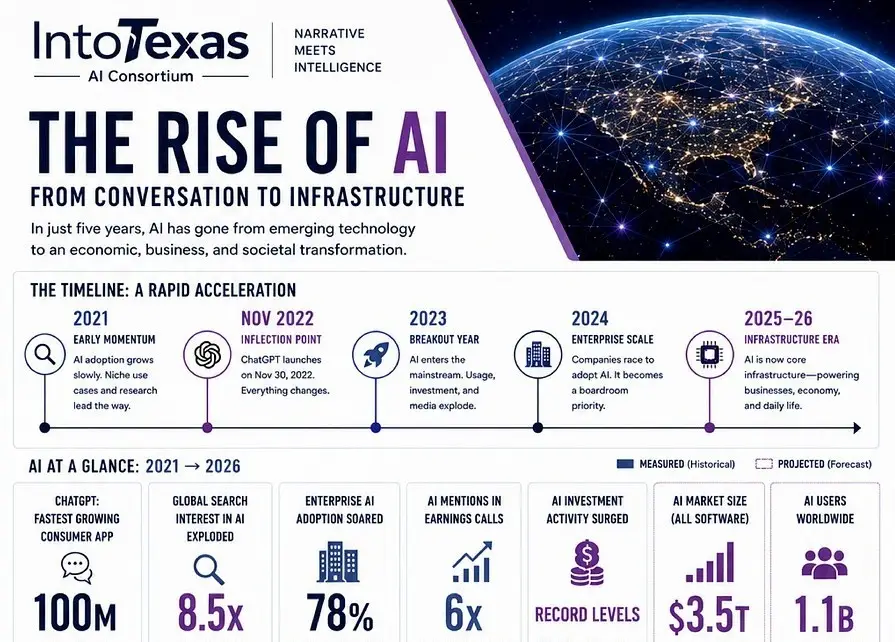

AI has moved from conversation to infrastructure. Explore the trends in adoption, investment, jobs, data centers and economic growth shaping the AI era.

Learn how to create practical AI guidelines by job function so employees know what to use, what to avoid and how their roles will change.
Find services, insights, articles and resources.