

Why AI Productivity Gains Do Not Show Up in the P&L
Learn why AI adoption and time savings often fail to improve financial performance, and how leaders can redesign workflows to capture measurable AI ROI.
 Shannon Belew
Share This Post
For the past several years, companies have spent a lot of time deciding what employees should not do with AI. Do not enter confidential information. Do not use unapproved tools. Do not publish AI-generated content without review. Do not let the model make a high-risk decision on its own.
Those rules are necessary. But they answer only one side of the workplace AI question.
What should employees be able to expect from the company when AI begins changing their work?
That is the question behind the Human-First Clause: a set of commitments that explains how an organization will treat its workforce when AI affects jobs, responsibilities, performance decisions or career paths.
This is not a proposal to freeze jobs in place or pretend that technology will not change how companies operate. It will. Some tasks will disappear. Some roles will narrow. Others will become more valuable. New jobs will emerge, and some existing positions will not survive in their current form.
But “change is inevitable” is not a workforce strategy.
A human-first policy asks leaders to be more explicit about how that change will happen, who will be involved and what protections should exist when the consequences become personal.
The next generation of AI governance may need to protect people as deliberately as it protects data, systems and intellectual property.
This discussion became very real in Texas when employees at The Texas Tribune ratified their first union contract. The agreement covers a relatively small workforce, but the AI provisions make it much more than a niche media story.
Under the contract, The Tribune committed not to lay off journalists to replace their news-gathering and reporting work with AI. Non-journalists laid off solely to implement AI receive an additional eight weeks of severance pay. The contract also includes guidelines on newsroom and employee use of AI.
The agreement does not reject AI. It does not ban new tools or insist that every job remain unchanged. It creates a boundary around displacement and gives workers more clarity about what happens if AI becomes a factor in an employment decision.
The Tribune is not the first organization to negotiate protections of this kind. Writers, performers and employees at other media organizations have pushed for limits on replacement, disclosure of AI use and continued human participation. But a Texas newsroom putting these ideas into a formal labor agreement makes the conversation harder for business leaders to dismiss as a distant policy debate.
It gives us an early glimpse of a workplace issue that is likely to move well beyond unions and creative industries.
Companies can debate whether AI is the primary cause of a particular layoff or simply one part of a broader restructuring. Workers experience the result either way.
Challenger, Gray & Christmas reported that employers cited AI in more than 54,000 announced job cuts during 2025. By mid-2026, AI continued to appear prominently in corporate explanations for technology-sector reductions and operating-model changes.
Some of those cuts may have happened without AI. Companies also reduce staff because of weak demand, duplication after years of hiring, investor pressure, changing business models and a desire to flatten management layers. “AI transformation” can become a convenient umbrella for several decisions at once.
But that does not make the workforce concern imaginary. AI is increasingly part of how companies describe future staffing needs, how they calculate productivity and how they decide which roles will grow, shrink or disappear.
Once AI enters those decisions, workforce governance can no longer be treated as an optional HR add-on.
Workplace AI conversations are often framed as a fight between people who embrace innovation and people who resist it. That framing is easy. It is also mostly useless.
Most employees understand that AI will become part of their work. Many are already using it. They see where it can eliminate tedious tasks, improve access to information and help them move faster.
What they do not want is to discover after the fact that the tool was also evaluating them, changing their performance expectations, monitoring their activity or building the business case for eliminating their position.
The underlying request is not “No AI.” It is much closer to this: Tell us what is changing. Tell us how decisions will be made. Give us a reasonable opportunity to adapt. Keep a human accountable for decisions that materially affect our careers.
Transparency, accountability, predictability and voice are not anti-innovation demands. They are the conditions that make difficult change more credible.
A human-first AI workplace policy does not need to guarantee lifetime employment. It should create a clear process for how the organization will use AI when people are directly affected. The specific commitments will vary by company, industry and risk level. Use the following six elements deserve serious consideration.
Before deploying AI in a way that affects jobs or employment decisions, leaders should be able to answer a short set of questions.
If the organization cannot answer those questions, it is not ready to call the deployment human-centered. It may not even be ready to call it governed.
This is also where HR must have a stronger role. Workplace AI is not simply a technology implementation with a communications plan attached. It changes expectations, power, career paths and sometimes the basic relationship between a worker and a manager.
The United States still has a fragmented approach to workplace AI protections. Europe has moved further toward treating many employment-related AI systems as high risk.
The European Union’s AI Act includes systems used in areas such as recruitment, worker selection, employment decisions, task allocation, performance monitoring and evaluation. Employers using covered high-risk systems must provide human oversight and, before workplace use, inform affected workers and their representatives.
The implementation timetable for some high-risk requirements has shifted, giving employers more time to prepare. The direction of travel has not changed: workplace AI requires documentation, transparency, oversight and a clearer explanation of how people are affected.
American employers do not need to copy the European framework in full to understand the larger point. A company can wait for every legal obligation to become explicit, or it can build a credible workforce policy before trust is damaged.
The most obvious fear is displacement. But human-first protections also matter when people keep their jobs.
Algorithmic management systems can assign work, monitor performance, rank employees, recommend schedules and influence managerial decisions. The International Labour Organization has warned that these systems can improve efficiency while also increasing surveillance, work intensity, privacy concerns and loss of autonomy.
An employee does not have to be laid off to feel that AI has changed the terms of employment. A person can remain on payroll while having less control, less understanding of how decisions are made and fewer opportunities to exercise judgment.
That is why a Human-First Clause should address both employment security and job quality. It should ask not only whether humans remain in the process, but whether their role is meaningful, informed and accountable.
Some leaders will hear “worker protections” and assume the proposal is primarily a concession to employees. I think that misses the business value.
AI adoption depends heavily on the people who understand the workflows, exceptions, customers and institutional history. When those employees believe the company is hiding its intentions, they become less likely to share knowledge, identify viable use cases or help redesign the work.
A clear policy does not eliminate fear. It reduces uncertainty. It tells employees that the organization has a process, that someone remains accountable and that people will not learn about major workforce changes through rumors or a sudden calendar invitation.
Trust also improves the quality of implementation. Employees who can raise concerns without being labeled resistant are more likely to catch flawed assumptions, biased data, unrealistic productivity targets and hidden work that leaders did not see.
The Human-First Clause is not charity. It is operating discipline for a transformation that depends on human participation.
Unions currently have the clearest mechanism for negotiating formal AI protections in the United States. Most American workers do not have that bargaining structure.
That creates an opening for employers to act voluntarily. A company could include human-first commitments in its responsible AI policy, employee handbook, workforce transformation plan or AI governance charter. It could also make those commitments part of recruiting and retention.
Imagine a job candidate comparing two employers. Both use AI extensively. One says only that employees must follow its acceptable-use policy. The other explains when AI is used in employment decisions, guarantees human review, commits to role-based training and describes what happens when automation materially changes a job.
Which company feels more trustworthy?
Workplace expectations can change faster than they initially appear. Remote and hybrid work moved from unusual benefits to mainstream recruiting issues in a very short period. AI transparency and transition commitments could follow a similar path.
We are well past debating whether or not AI will change work. The more important question is how much clarity, participation and protection people should have while it happens.
The Texas Tribune contract will not define the future of work. But it may be one of the early examples we look back on when human-first AI commitments become a normal part of employment policy.
The strongest workplace AI strategies will not pretend that every transition can be painless. They will be candid about what is changing and disciplined about how decisions are made.
This is not humans versus AI. It is a question of whether organizations can adopt AI without treating the people affected by it as an afterthought.
A company’s AI values become real when they protect people at the moment those values are hardest to uphold.
Sources
Share This Post
Learn why AI adoption and time savings often fail to improve financial performance, and how leaders can redesign workflows to capture measurable AI ROI.
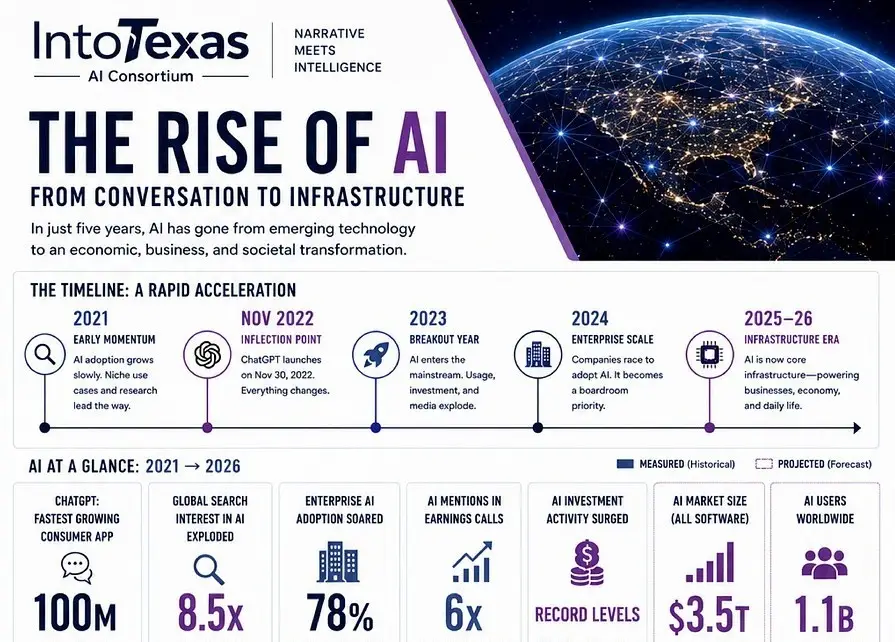

AI has moved from conversation to infrastructure. Explore the trends in adoption, investment, jobs, data centers and economic growth shaping the AI era.
Learn how leaders can redesign work, map human and AI responsibilities, and avoid costly AI-driven layoffs followed by correction hires.
Find services, insights, articles and resources.