

Why AI Productivity Gains Do Not Show Up in the P&L
Learn why AI adoption and time savings often fail to improve financial performance, and how leaders can redesign workflows to capture measurable AI ROI.
 Shannon Belew
Share This Post
For years, autonomous vehicles were discussed as something that was coming. In Texas, they have arrived.
Robotaxis are carrying passengers. Driverless trucks are moving freight. Autonomous delivery vehicles are working defined routes. And now Texas has moved beyond being a permissive testing ground and created a formal authorization system for commercial autonomous vehicles.
That is the real turning point: Texas is no longer only hosting autonomous vehicle experiments. It is beginning to regulate a functioning industry.
Under Senate Bill 2807, companies commercially operating automated vehicles without a human driver must maintain an active authorization from the Texas Department of Motor Vehicles. The requirements became enforceable on May 28, 2026, after the final administrative rules took effect earlier in the year.
The law applies to companies operating automated vehicles commercially to transport passengers or goods. That includes robotaxis, autonomous delivery fleets and driverless freight operations.
Operators must certify that each vehicle complies with Texas traffic and motor vehicle laws, has a required recording device, uses an automated driving system that complies with federal law, can reach a minimal risk condition if the system fails and carries required insurance. They must also certify that the Texas Department of Public Safety has received their emergency response interaction plan. TxDMV can restrict operations or revoke an authorization, while the Department of Public Safety and local law enforcement keep authority over on-road safety and traffic enforcement.
There is no fee to obtain an authorization. That tells you something about the balance Texas is trying to strike. The state is not trying to make market entry difficult. It is trying to create a minimum structure for accountability while preserving the business-friendly environment that attracted autonomous vehicle companies in the first place.
One of the most practical outcomes of the new system is public visibility. Texas residents and law enforcement can now verify whether a commercial operator is authorized and review the vehicles registered under that authorization.
That may sound administrative, but it is a meaningful change. Before the new system, it was difficult for the public to understand how many autonomous vehicles were actually operating in Texas or which companies were responsible for them. The state’s lookup tool creates a basic layer of transparency around an industry that has often expanded faster than public reporting.
Initial registration data also revealed the scale of the market. Waymo registered the largest fleet in Texas, followed by Avride, with smaller fleets from companies including Nuro and Tesla. The exact numbers will continue to change, so the more important development is the existence of a live state record rather than any one snapshot.
Texas also launched a complaint process for serious public-safety concerns. That gives the state a direct mechanism to connect real-world incidents with administrative enforcement.
The autonomous vehicle story in Texas is not limited to robotaxis.
Passenger mobility gets the most attention because a driverless car moving through downtown traffic is visible and easy to understand. But Texas is also a major proving ground for autonomous freight, industrial operations and delivery systems.
The state’s geography helps explain why. Texas has large cities, long freight corridors, ports, energy operations, sprawling suburbs and major logistics networks. It offers companies multiple operating environments without requiring them to leave the state.
An autonomous trucking company can test highway freight movement, industrial routes and remote operations. A robotaxi company can learn from dense urban traffic, suburban roads, construction zones, extreme heat and severe weather. A delivery company can operate in controlled commercial routes before expanding into more complex environments.
That combination makes Texas unusually valuable to the industry. It also means the state is encountering many of the policy questions before other markets do.
Traditional vehicle regulation is built around a fairly stable product. A vehicle model is tested, approved, manufactured and then maintained.
Autonomous vehicles complicate that logic because the driving system is software. It can be updated. Its models can change. Its operating boundaries can expand. The vehicle approved today may behave differently after a major software release.
Researchers at The University of Texas at Austin have been exploring what they call dynamic or lifelong certification. Instead of treating safety approval as a single checkpoint, the concept treats certification as an ongoing process that adapts as the system, its environment and the evidence about its performance change.
That is a much better match for AI systems. Autonomous vehicles encounter conditions that cannot all be anticipated during pre-deployment testing: flooded roads, unusual construction patterns, emergency scenes, human drivers behaving unpredictably and combinations of events the system has never seen.
A static authorization can establish who is allowed to operate. It cannot, by itself, prove that a continuously changing system will behave safely in every future condition.
The most revealing autonomous vehicle failures are often not routine lane changes on a clear day. They are edge cases involving emergencies, weather, blocked roads, ambiguous instructions or competing safety priorities.
Texas has already seen incidents involving autonomous vehicles near emergency response activity, vehicles entering flooded roadways and robotaxis behaving unpredictably in live traffic. These incidents do not necessarily prove the entire technology is unsafe. They do show why real-world monitoring matters.
An autonomous vehicle may follow its normal driving logic perfectly and still make the wrong decision for the situation. A human driver understands that an ambulance, a police officer waving traffic through or rising floodwater changes the normal rules. Teaching a system to recognize those exceptions consistently is a much harder problem.
NHTSA requires certain crashes involving automated driving systems to be reported and can investigate patterns that raise safety concerns. Federal oversight, state authorization and local first-responder experience are all becoming parts of the same regulatory picture.
Texas made a sensible move by creating one statewide authorization framework. Companies benefit from consistent rules rather than a different regulatory structure in every city. The state also gained the authority to restrict or revoke operations and created a public process for reporting serious concerns.
But the framework still leaves difficult questions.
How frequently should performance be reviewed after authorization? What data should operators share with the state, cities and researchers? How should a regulator respond to a software update that materially changes driving behavior? What is the right threshold for suspending an operator? And how should local emergency responders influence rules when cities remain limited in their ability to regulate autonomous vehicles independently?
The answers will probably not come from one law. They will develop through enforcement decisions, incident data, company behavior, research and public pressure.
The Texas experience offers a broader lesson for AI governance. The more an AI system changes after deployment, the less useful one-time approval becomes.
Alternatively, a stronger oversight model would include these continuing responsibilities:
Autonomous vehicles are often framed as a technology story. In Texas, they are also an economic-development, logistics and infrastructure story.
The state has the opportunity to attract investment, engineering talent, fleet operations, maintenance, data services and new transportation business models. Autonomous freight could be especially important in a state where logistics, energy, manufacturing and cross-border trade are central to the economy.
But sustained growth depends on more than allowing companies to operate. Public trust is part of the market infrastructure.
A robotaxi service that repeatedly strands riders, blocks emergency vehicles or behaves badly in severe weather will not build confidence simply because the technology is impressive. Likewise, an autonomous trucking company will not scale successfully if first responders, insurers, local communities or commercial customers do not trust its operating practices.
Good regulation does not have to be anti-innovation. Done well, it creates the predictability that serious companies need and the accountability the public expects.
Texas has already proven that it can attract autonomous vehicle companies. The next question is whether it can build an oversight system that keeps pace with them.
The new authorization program is an important first step. It establishes who may operate, creates a public record and gives the state enforcement authority. But autonomous vehicles are learning systems operating in an unpredictable world. The regulatory model will have to learn, too.
Texas is moving from open roads to accountable autonomy. Whether that model works will depend on what happens after the authorization is issued.
Sources
Share This Post
Learn why AI adoption and time savings often fail to improve financial performance, and how leaders can redesign workflows to capture measurable AI ROI.
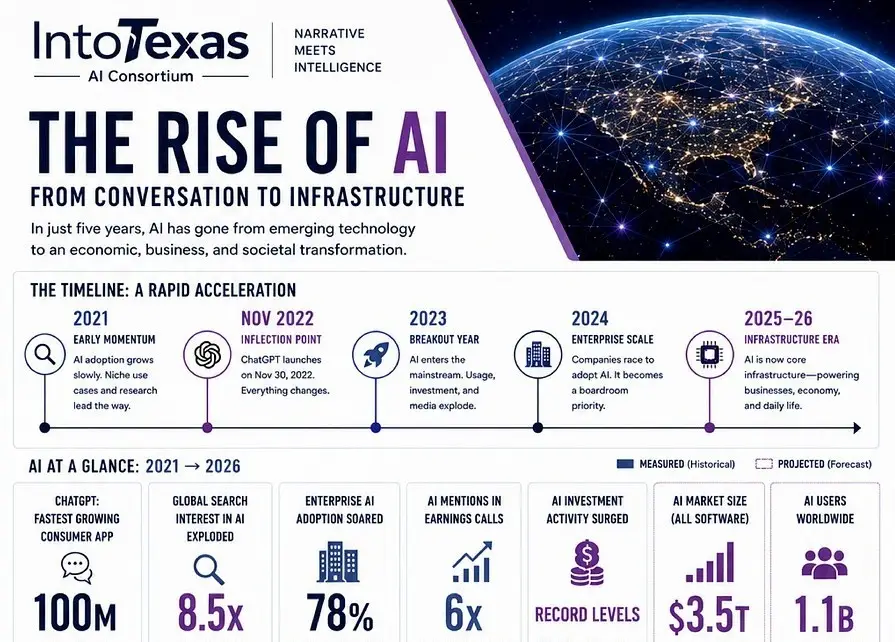

AI has moved from conversation to infrastructure. Explore the trends in adoption, investment, jobs, data centers and economic growth shaping the AI era.
Learn how leaders can redesign work, map human and AI responsibilities, and avoid costly AI-driven layoffs followed by correction hires.
Find services, insights, articles and resources.